


Then, it goes to the right department based on the document type. Education certificates go to the HRD, personal documents like birth or marriage certificates go to the Home Department, and business documents go to the Chamber of Commerce Attestation.
Embassy Attestation
Do you also need embassy attestation? Are you also thinking of going to a Gulf country like the UAE, Saudi Arabia, or Qatar to study, live, or do business? If yes, then you must get embassy attestation done. Gulf countries are not part of the Hague Convention, so embassy attestation is required in Gulf countries. Our team will guide you through this process correctly, accurately, and without any confusion. We provide fast, cheap, and genuine services.
Embassy Attestation in India
To put it simply, embassy Attestation is when the embassy puts its official stamp on your document, whether it’s a degree certificate, birth certificate, or marriage certificate, to ensure that it’s genuine and not a fake. If you skip this step, most countries won’t accept your papers for visa applications, job processing, or entry purposes.
However, before it reaches the embassy stage, your document first has to go through notarial authentication and then state-level Attestation. Only once it clears these does it proceed to the embassy for the final stamp. Typically, you’ll need the original document, a copy of your passport, two passport-sized photos, and, depending on your case, perhaps a visa copy or job offer letter as well.
The whole thing usually takes a week or two, give or take, and the cost is not fixed; it varies depending on which country you’re dealing with and what type of document it is. To be honest, many people engage an agent just to avoid the rush, although it’s not impossible to do it yourself if you have the patience.
Process of Embassy Attestation in India
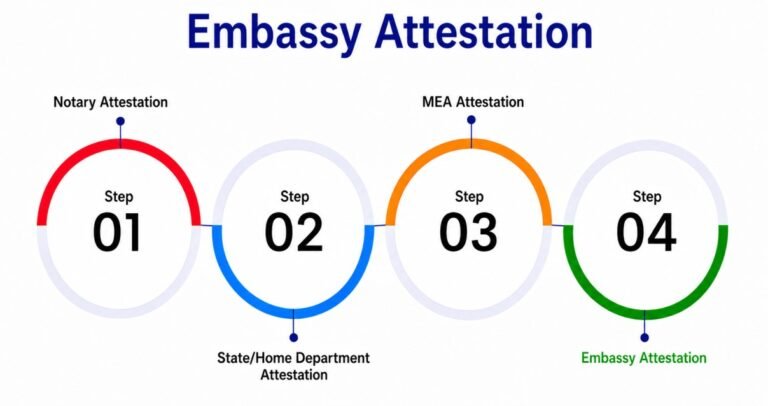
Getting a document certified for use abroad in India means it has to go through four stages before it can actually be accepted anywhere.
Embassy Attestation Procedure in India
The Embassy Attestation process in India is in these 4 steps:
Step 1
Notary Attestation
It all starts with the local notary. They first verify your document, and this basic check has to be done before any other office touches it.
Step 2
State/Home Department Attestation
Step 3
MEA Authentication
After approval by the state, the document goes to the Ministry of External Affairs. This is basically the central government confirming that the document is legal before it leaves the country.
Step 4
Embassy Authentication
The final stop is the embassy or consulate of the country you are planning to visit. Once they stamp it, that country officially recognizes your document as valid.
At PCC, we take care of the entire four-step authentication process for you – notary, State Department, MEA, and embassy – so you don’t get stuck running from one office to the next. Simply hand us your documents, and we’ll handle all the paperwork and follow-ups until everything is authenticated and ready to use.
Timeline of Embassy Attestation in India
Embassy attestation isn’t a quick process; it generally takes around 7 to 15 working days, and honestly, it can stretch even longer depending on which country’s embassy you’re dealing with and what type of document you’ve submitted. Since the paper has to pass through several hands before it even reaches the embassy, some delay is just part of the deal.
Multiple stages involved
Notary, then State Department, then MEA; each one adds a few days before your document reaches the embassy.
Embassy Working Days and Holidays
Not just Indian holidays, their home country's calendar too. Bad timing means your document waits till they're back at work.
Document Verification Process
If they need to verify anything with the State Department or MEA, that adds extra days.
Application Volume
Admission and visa season bring a flood of applications, so everyone's wait gets longer.
Embassy Attestation Charges in India
Embassy authentication charges may not be limited to a fixed number; they vary depending on the country you are dealing with, the type of document, and how quickly you need it returned. On average, you are looking at a price of two thousand rupees to ten thousand rupees, and Gulf countries like the UAE, Saudi Arabia, or Qatar tend to have higher rates because their process involves more steps.
Here are the reasons why the price actually increases or decreases:
Type of document – Academic certificates, personal documents, and commercial papers all come with their own fee structure, and commercial papers usually cost more because they require additional verification.
Destination country – Each embassy sets its own fees, so what you pay for the UAE may not match what you pay for Kuwait or Qatar.
Urgency of the process – Do you want it done quickly? Urgent or expedited processing will cost you more than the regular route.
Agent or service fees – If you are not handling this yourself and are going through an agent, expect an additional service fee on top of what the embassy charges.
Note: There is no fixed charge for embassy attestation; it depends on factors and circumstances.
Get Your Quote
Which document needs attestation? Fill in the details below to receive a quote.
Required Documents for Embassy Attestation
Essential Documents
The basic documents required for Embassy Attestation:
- Original document that needs attestation – degree certificate, birth certificate, marriage certificate, whatever applies to you
- Passport copy of the applicant, both front and back pages
- Passport-size photographs, usually somewhere between 2 and 4 depending on what the embassy wants
- Application form, filled out according to the embassy’s own format
Optional Documents
Some additional documents may be required depending on the document type and destination country:
- Visa copy or visa application
- Employment offer letter
- Authorization letter
- Admission letter, if the attestation is required for study purposes
- Emirates ID or residence visa copy
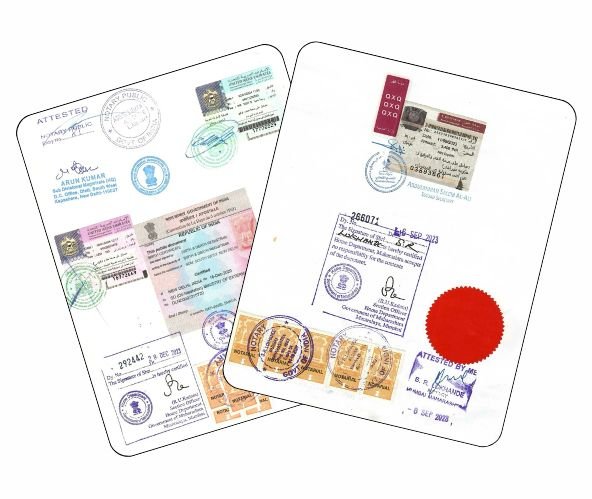
The essential documents are pretty much needed no matter what case you fall under, but the optional ones really depend on your specific reason for attestation and which embassy you’re dealing with. Honestly, it’s always worth double-checking with the embassy or your agent beforehand, since requirements can shift a bit from one country to another.
How to Get Embassy Attestation in India with 4 easy steps
Getting your commercial documents ready for overseas use starts with proper Embassy Attestation Here’s how the PCC works.
Send Us an Enquiry
Call us, message us on WhatsApp, or fill out the enquiry form on our page. Mention the country you’re applying to and the document type; we’ll tell you the charges and roughly how many days it’ll take.
Submit Your Documents
Send us your original documents by courier if you can’t come in. Along with that, we’ll need your passport copy and photographs.
We Take Care of the Process
This part is on us. Notary, state department, MEA, embassy- we handle the visits and follow-ups ourselves so nothing gets stuck along the way.
Get Your Document Back
Once the embassy attests it, we return your document to you through courier or handover, and it’s good to use for your job, studies, or visa.
Embassy Attestation Services for Popular Countries
We handle attestation for most of the major destinations people apply to, and since every country has its own process and requirements, we make sure things are done exactly the way each embassy expects. Here are the countries we work with most often:
- UAE Embassy Attestation
- Saudi Arabia Embassy Attestation
- Qatar Embassy Attestation
- Kuwait Embassy Attestation
- Oman Embassy Attestation
- Bahrain Embassy Attestation
- Yemen Embassy Attestation
- China Embassy Attestation
- Egypt Embassy Attestation
- Vietnam Embassy Attestation
Why is embassy certification necessary?
Embassy certification exists because no country will just take your word for it that a document is genuine – they need proof that it is real and issued by a recognized authority in their home country. Here’s why it’s really important:
- It confirms that your document isn’t fake or tampered with, which is required before foreign authorities can officially accept it.
- Visa officials won’t process your application without it, as uncertified documents are simply not considered valid evidence in most countries.
- Employers abroad demand it to make sure your degree or work experience certificate is actually legitimate before hiring you.
- Universities require it to verify your educational background before granting admission.
- It’s often mandatory for family visa cases, such as when you’re sponsoring a spouse or child, as birth and marriage certificates need to be proven authentic.
- Government offices in the destination country rely on it to prevent fake documents from slipping through their systems.
- Without it, many processes simply stall; your paperwork is rejected or stuck until the certification is resolved.
Validity of Embassy Attestation in India
There is no specific expiration date stamped on an embassy Attestation, but that doesn’t mean that whatever it is, it will be valid forever. Typically, it will be valid as long as the original document itself remains valid, so something permanent like a degree certificate doesn’t really “expire” in that sense. But documents like a police clearance certificate may need to be re-authenticated if a lot of time has passed since it was issued. Some embassies also prefer that the Attestation be recent, such as within the last six months to a year, especially when it’s for visa purposes. Since this isn’t the same in every country, it’s always a good idea to check directly with the embassy you’re dealing with to make sure your certificate is ready for use when you need it.
Common Problems People Face With Embassy Attestation
– Unpredictable timelines:
One embassy might clear your documents in 2-3 days, another could take a month for the exact same type of paper. There’s no fixed pattern to rely on.
– Requirements shift without notice:
What worked for someone last month might not work for you today. Embassies update their rules on their own schedule, and half the time this info doesn’t even make it to their website.
– Sudden demand for extra paperwork:
You show up thinking you have everything, and then you’re told to bring a salary slip, an employer letter, or a notarized copy you never knew was needed.
– Restricted working hours:
Several embassies are open only a couple of days a week, sometimes for just a few hours at a stretch. Planning around this eats up more time than the attestation itself.
– Urgent requests cost extra:
Need it fast? That’ll cost you. Emergency processing fees can be steep, which stings even more when you’re already spending on visa or relocation expenses.
Why Choose Us?
Personal Assistance
Live Tracking
Zero Paperwork Hassle
100% Genuine Approvals
You Ask, We Answer
Frequently Asked Questions
Can a damaged or incorrect document still be attested?
Honestly, it’s a bit risky; embassies want the document in its original, clean form, and if there are any alterations or overwritings on it, they are likely to reject it. It’s better to issue a new copy before you start.
Do I need to be in India throughout the process?
Absolutely not; once you submit your documents and give someone, say an agent, the appropriate authorization letter, the process continues even if you’re not around.
What happens if I lose my document after it’s already attested?
You’ll have to first get a duplicate from the issuing authority, and then go through the entire Attestation process again from the beginning, since it’s tied to a specific document.
Can I use one Attested document for more than one thing?
Yes, that's fine - as long as the document and its Attestation have not lost their validity, you can use the same document without having to do it again for a job, visa, or anything else you need.
Is embassy attestation the same as apostille?
No, they're different processes - apostille is a single-step certification recognized by Hague Convention countries, while embassy attestation involves multiple stages and is required for countries that aren't part of that convention, like most Gulf nations.
Need Any Consultations?


