


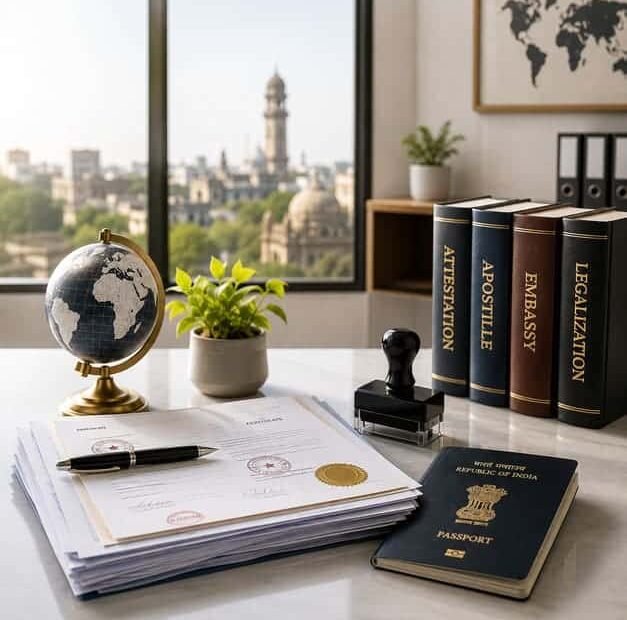
In recent years, international opportunities have attracted many Indians seeking higher education, overseas jobs, business expansion and family reunification. Government statistics reflect this trend, with lakhs of Indians travelling abroad for education and employment every year.
With more Indians exploring international opportunities, proper document preparation and authentication have become important parts of the application process. As part of the process, applicants often need to prepare and authenticate important documents through apostille or embassy attestation.
Depending on the purpose of travel and destination country, applicants may need to submit educational certificates, birth certificates, marriage certificates, experience certificates, police clearance certificates, affidavits and commercial documents. These documents may require apostille or embassy attestation to verify the authenticity of their signatures, seals or stamps before they can be accepted by foreign universities, employers, immigration departments and government authorities.
Completing the required document authentication process in advance can help avoid documentation issues and unnecessary delays during international applications.
What Is Apostille Attestation?
An apostille is an official authentication issued by the Ministry of External Affairs (MEA), India, for documents intended for use in countries where the Hague Apostille Convention applies. It verifies the signature, seal or stamp on a document, making it acceptable abroad without separate embassy legalisation.
Attestation is the process of verifying a document’s authenticity for use in foreign countries. Depending on the document and destination country, it may involve Notary, State Government, MEA and embassy authentication. It is commonly required for educational, personal and commercial documents.
Step-by-Step Guide To Apostille & Attestation
Apostille Process & Timeline
How It Works:
Time: Generally 3 to 5 working days after MEA receives the document, plus time for prior verification and delivery.
Attestation Process & Timeline
How It Works:
Time: Generally 7 to 12 working days, depending on the document type and embassy requirements.
Why Do Indian Documents Need Apostille Attestation?
International education, overseas employment, business activities and family relocation often require Indians to submit authenticated documents abroad. Foreign universities, employers and government authorities may request apostilled documents to verify their authenticity.
In India, the MEA issues apostilles for eligible public documents intended for use in countries where the Hague Apostille Convention applies.
Here are the people who may need apostille attestation in 2026:
Official Document Validation
Helps establish document authenticity.
Cross-Border Acceptance
Supports document use in Convention countries.
Overseas Qualification Checks
Helps authenticate academic records.
International Family Matters
Supports personal document submissions abroad.
Foreign Authority Requirements
Helps meet document legalisation rules.
Global Business Operations
Facilitates commercial document authentication.
Simplified Legalisation
Reduces additional authentication steps.
Secure Document Verification
Helps confirm the origin of official documents.
Apostille vs Embassy Attestation: Key Differences and Features
| Features | Apostille Attestation | Embassy Attestation |
|---|---|---|
| Purpose | Authenticates documents for use in Hague Convention member countries. | Authenticates documents for use in countries requiring embassy legalisation. |
| Issuing Authority | Ministry of External Affairs (MEA), India. | MEA followed by the concerned country’s embassy or consulate. |
| Applicable Countries | Countries where the Hague Apostille Convention is in force. | Countries that require embassy legalisation and are not covered by the Convention. |
| Authentication Process | State-level or other required verification followed by MEA apostille. | Document verification, state-level authentication, MEA attestation and embassy legalisation, as applicable. |
| Document Types | Personal, educational and commercial documents. | Personal, educational and commercial documents. |
| Embassy Visit | Separate embassy legalisation is generally not required. | Embassy or consulate authentication is required. |
| Final Authentication | Apostille sticker attached to the document. | Embassy or consulate attestation stamp or certificate. |
| Common Purpose | Overseas employment, education, family visas and business activities. | Overseas employment, education, immigration and business formalities. |
Note: The UAE, Qatar and Kuwait are not part of the Hague Apostille Convention, so documents for use in these countries generally require embassy attestation. Choosing the wrong process can cause delays and extra costs. Always confirm the latest requirements before starting document authentication.
When Do You Need An Apostille?
You generally need an MEA apostille when:
– Your document is issued or certified in India.
– It is intended for official use abroad.
– The destination country recognises the Hague Apostille Convention.
Common Situations Where Apostille Is Required
– Overseas Employment: For submitting educational and professional certificates to foreign employers.
– Higher Education: For university admissions, degree verification and academic applications abroad.
– Immigration and Family Visas: For birth certificates, marriage certificates and other personal documents.
– NRI Documentation: For using Indian-issued documents with foreign authorities while living abroad.
– Business Activities: For company registration, commercial agreements and international business transactions.
When Do You Need Embassy Attestation?
Embassy attestation is generally required when your destination country is not covered by the Hague Apostille Convention.
Common Destinations Requiring Embassy Attestation
– UAE: Indian documents generally require State Authentication, MEA Attestation, UAE Embassy Attestation and UAE MOFA.
– Qatar: Requires the applicable MEA and Qatar Embassy Attestation process.
– Kuwait: Requires Kuwait Embassy Attestation after the necessary document verification and MEA authentication.
– Jordan, Iraq, Yemen and Libya: Generally require embassy legalisation for Indian documents.
Latest Updates In Apostille Attestation For 2026
Saudi Arabia Accepts Apostille
Saudi Arabia joined the Hague Apostille Convention in 2022, and it came into force on 7 December 2022. Indian documents intended for use in Saudi Arabia can generally follow the MEA Apostille process instead of the traditional embassy legalisation route.
What Applicants Should Know:
– Personal documents may require MEA Apostille.
– Educational documents may need additional Saudi Cultural or professional verification.
Germany’s Objection to India’s Apostille Accession
Germany has formally objected to India’s accession to the Hague Apostille Convention under Article 12. Therefore, Indian apostilles are not automatically recognised for use in Germany under the Convention.
What Applicants Should Know:
– An MEA Apostille alone may not be sufficient for German authorities.
– Additional document verification or legalisation may be required.
– Requirements may differ for educational, personal and commercial documents.
Vietnam Joins the Hague Apostille Convention in September 2026
Vietnam’s accession to the Hague Apostille Convention takes effect on 11 September 2026. From this date, eligible Indian public documents intended for use in Vietnam can generally follow the MEA Apostille process instead of traditional embassy legalisation.
What Applicants Should Know:
– Students may need apostilled academic certificates.
– Professionals may require apostilled employment and educational documents.
– Personal documents, such as birth and marriage certificates, may also require apostille.
Algeria: Apostille Process Effective from 9 July 2026
Algeria became part of the Hague Apostille Convention on 9 July 2026. From this date, eligible Indian public documents intended for use in Algeria can generally be authenticated through the MEA Apostille process, replacing the traditional embassy legalisation route.
What Applicants Should Know:
– Educational documents may need HRD or State verification.
– Personal documents may require State authentication.
– Commercial documents may need Chamber of Commerce verification.
Thailand: Apostille Convention to Take Effect on 28 February 2027
Thailand deposited its instrument of accession to the Hague Apostille Convention on 30 June 2026. However, the Convention will enter into force for Thailand on 28 February 2027. Until then, Indian documents intended for use in Thailand should generally follow the existing embassy legalisation procedure.
What Applicants Should Know:
– Educational certificates may require verification from the relevant State or HRD authority.
– Personal documents may need Notary and State-Level Authentication, depending on the document.
– Commercial documents may require Chamber of Commerce verification.
– MEA Attestation and Thailand Embassy legalisation should be completed before submission to the receiving authority.
Saudi Arabia: Apostille Process Applicable Since 7 December 2022
Saudi Arabia became a member of the Hague Apostille Convention, which entered into force on 7 December 2022. Since then, eligible Indian public documents intended for use in Saudi Arabia can generally follow the MEA Apostille process instead of the traditional embassy legalisation route.
What Applicants Should Know:
– Educational certificates may require Saudi Cultural verification.
– Professional documents may need licensing authority approval.
– Personal documents may require State-Level Authentication.
Frequently Asked Questions
1) Is An Apostille Required For Translated Documents?
It depends on the receiving country’s requirements. Some authorities require the original document to be apostilled before translation, while others may also require the translated version to be authenticated.
2) How Do I Know If My Destination Country Is A Hague Convention Member?
You can check the official country status list on the Hague Conference on Private International Law (HCCH) website. Or contact PCC PVT. LTD. Our team can help confirm the applicable apostille or embassy attestation requirements before you begin the process.
3) Why Does Apostille Processing Take Longer For Educational Certificates?
Educational certificates may take longer because they often require verification from the issuing university, education board, or State HRD Department before you submit them to the MEA for apostille.
4) Can I Apostille A Document More Than Once?
A document may be submitted again if a new apostille is required, but the need depends on the receiving authority and the condition of the existing authentication.
5) Does Every Page Of A Document Need A Separate Apostille?
No, not every page requires a separate apostille. Generally, one apostille is issued for each eligible document, depending on its format and the applicable MEA authentication procedure.
6) What Happens If My Document Fails State Level Verification?
You may need to contact the issuing authority to correct discrepancies or provide additional supporting documents before resubmission.
7) Do Newly Joined Convention Countries Require A Different Apostille Sticker?
No, newly joined Hague Apostille Convention countries do not generally require a different apostille sticker. The apostille follows the standard format prescribed by the 1961 Convention, regardless of when a country joins.
